YZi Labs: Building the Digital Berkshire of the AI & Web3 Economy
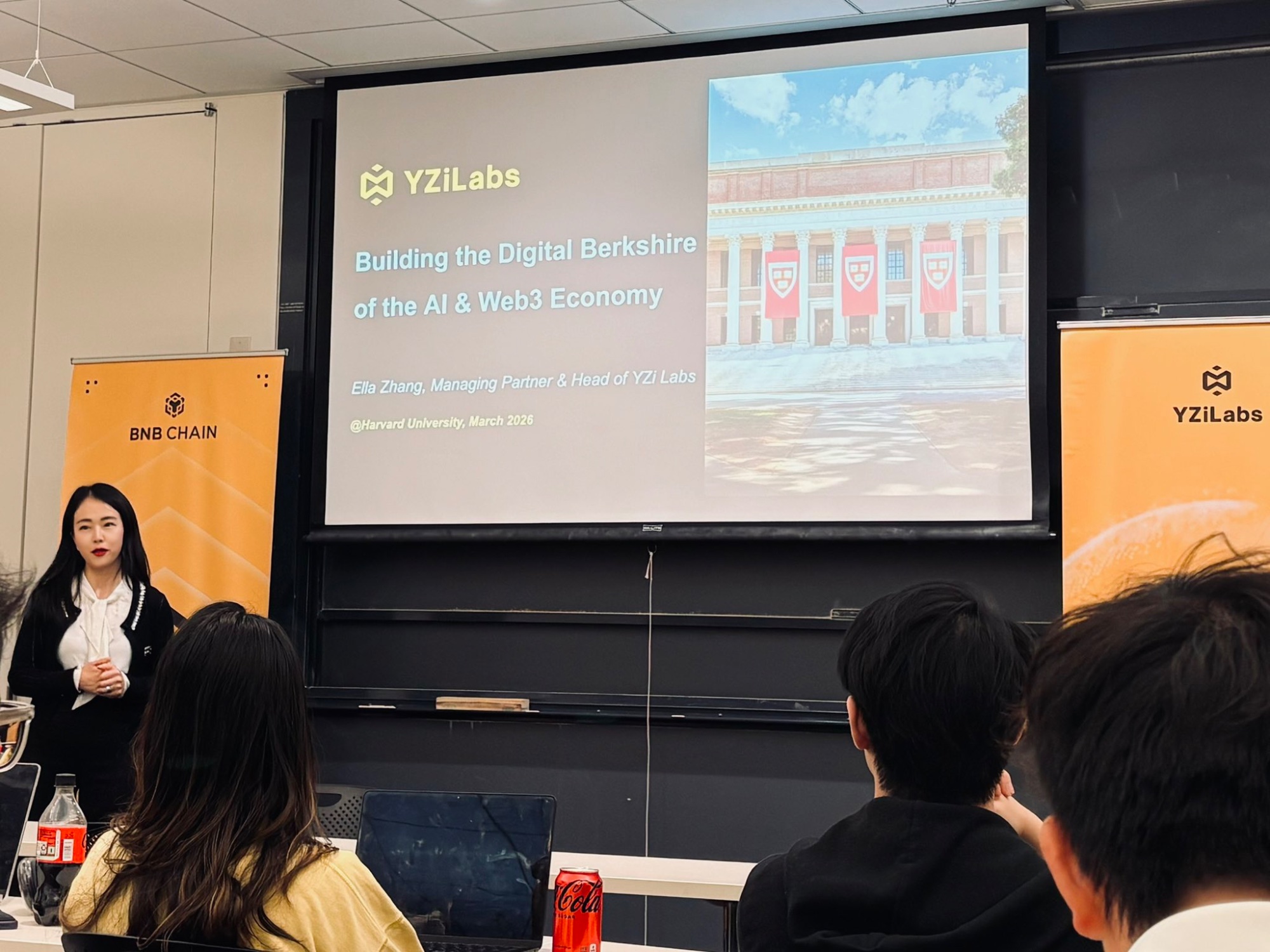
Ella Zhang, Managing Partner & Head of YZi Labs, presenting at Harvard University, March 2026 — flanked by BNB Chain and YZi Labs branding
"Building the Digital Berkshire of the AI & Web3 Economy." That was the title on the screen as Ella Zhang took the stage at Harvard University in March 2026. It's a bold claim — invoking Warren Buffett's conglomerate in the same breath as decentralised technology. But when the entity behind the claim manages a portfolio of 250+ projects across 25 countries with over $10 billion in assets, it starts to feel less like ambition and more like a roadmap.
YZi Labs, formerly Binance Labs, has quietly become one of the most consequential capital allocators in the AI and Web3 space. And understanding how they think is essential for anyone building at this intersection.
From Binance Labs to YZi Labs
In January 2025, Binance Labs rebranded to YZi Labs, transitioning from an internal venture arm of the world's largest crypto exchange into an independent family office for Binance co-founders Changpeng "CZ" Zhao and Yi He. The name change wasn't cosmetic — it reflected a fundamental expansion of mandate.
Where Binance Labs focused primarily on Web3 and blockchain projects, YZi Labs now invests across three pillars: artificial intelligence, biotechnology, and Web3. The thesis is that these three technology waves are converging, and the firms that position across all three will define the next era of global infrastructure.
CZ, after stepping down as Binance CEO, now takes a hands-on role mentoring startups and guiding strategic investments within YZi Labs. Ella Zhang, who originally founded Binance Labs, returned to lead the new entity — bringing her experience from Kleiner Perkins, Tencent, Google, and two AI startup co-foundations to the helm.
"Focus on the things that haven't happened yet"
At Consensus Hong Kong 2026, Zhang articulated YZi Labs' investment philosophy with a clarity that cuts through the noise of crypto venture capital. The core thesis is deceptively simple: back founders building what doesn't yet exist, with real user demand and product-market fit outweighing trend chasing.
This isn't the typical "spray and pray" VC model that has defined much of crypto investing. YZi Labs employs what Zhang calls a "barbell strategy" — balancing high-risk early-stage incubations with mature, market-tested projects. On one end: the EASY Residency programme, a 10-week offline incubator offering $500K per startup with deep, personalised support. On the other: direct investments into proven infrastructure and growth-stage protocols.
The first EASY Residency cohort attracted over 1,000 applications — 47% focused on AI, 30% on Web3. That ratio alone tells you where the smart money sees opportunity forming.
BNB Chain as the distribution layer
One of YZi Labs' structural advantages is its relationship with BNB Chain. With thousands of deployed protocols and hundreds of millions of users, BNB Chain provides a natural distribution layer for portfolio companies. This isn't just capital deployment — it's ecosystem insertion.
For founders, this means that a YZi Labs investment comes with immediate access to one of the largest user bases in Web3, along with integration pathways to platforms like Trust Wallet, CoinMarketCap, and the broader Binance ecosystem. It's the kind of distribution advantage that most VCs simply cannot offer.
Empathy-driven investing
Perhaps the most distinctive aspect of YZi Labs' approach is what Zhang describes as "empathy-driven investing." In a space known for ruthless deal-making and short-term exits, YZi Labs prioritises founder resilience and long-term value creation over quick returns.
Zhang has publicly stated that YZi is "very, very open for the founders to fail and welcome them to come back" — framing failure as part of long-term founder development rather than a disqualifying event. This philosophy stands in stark contrast to the typical crypto VC model, where a failed token launch often means permanent exile from the fundraising circuit.
After rejoining, Zhang initiated in-depth conversations with every portfolio founder to identify their most critical needs. The answers were overwhelmingly consistent: marketing and talent acquisition. In response, YZi Labs began leveraging its BD network to connect B2B projects with partners and using community and influencer resources to support B2C projects. This is hands-on capital deployment at its most effective.
Stablecoins, infrastructure, and the path to mass adoption
On where the industry is heading, Zhang has been characteristically direct. She identifies stablecoins as the first true mass-market crypto application beyond trading — citing improving compliance frameworks globally as the catalyst for broader adoption.
But she also sees significant infrastructure work still ahead: custody solutions, exchange infrastructure, and on-chain FX need to mature before stablecoins can fully serve as the backbone of global commerce. This is a measured view in a market that tends toward hyperbole — and it's the kind of perspective that separates institutional-grade investors from the noise.
Lessons for builders
Whether or not you're seeking YZi Labs capital, their thesis offers a strategic framework worth studying:
- Build for what doesn't exist yet — the most valuable ventures aren't iterating on existing products. They're creating categories.
- Real users over speculation — product-market fit with genuine demand always outperforms narrative-driven projects in the long run.
- The barbell works — balancing high-conviction early bets with proven growth-stage investments creates portfolios that survive cycles.
- Distribution is infrastructure — the best product in the world is worth nothing without a path to users. Build distribution partnerships before you need them.
- Failure is data, not death — the founders who build the biggest things are rarely the ones who got it right the first time.
- Cross-sector convergence — AI, biotech, and Web3 are converging. Builders who understand multiple domains will have structural advantages.